
By Jon Regardie
Shortly after the Los Angeles Homeless Services Authority released the results of the 2026 Homeless Count in July, mayoral challenger Nithya Raman held a Studio City press conference. She blasted the 7.9% year-over-year increase in unsheltered people citywide as evidence of Mayor Karen Bass’ failed approach—and then contrasted it with the eye-popping 49% drop in the Fourth District, which the second-term councilmember represents.
Raman hit the point again in an Aug. 10 video after she was removed from chairing the City Council’s Housing & Homelessness Committee, and repeated it at the Aug. 19 debate against Mayor Karen Bass. “We can use our scarce resources to actually end street homelessness,” Raman declared at the testy event hosted by the Sherman Oaks Homeowners Association. “In my district last year, we reduced street homelessness by 49%.”
As the November mayoral election approaches, Raman’s 49% drop is emerging as the single most important statistic in the race. Naturally, it is splashed across the front page of her campaign website.
Homelessness was a defining issue in Bass’ 2022 mayoral run and has been a focal point of her administration. She frequently highlights that the number of unhoused people in the city fell two years in a row for the first time in history before this year’s uptick. She has asserted that her Inside Safe initiative to target encampments contributed heavily to the decline in Raman’s Silver Lake-to-Reseda district.
Raman’s jaw-dropping 49% reduction claim accurately cites the data collected by LAHSA. At the same time, it is also merely a snapshot of a single year, cherry-picked to maximize the candidate’s effectiveness. To more accurately calculate how much credit Raman deserves, it helps to pull the camera back and take a broader look at all the available data.
This article attempts to do just that. L.A. Reported examined the LAHSA numbers, digging into the authority’s local data dashboards for a greater understanding of how homelessness has changed in each of L.A.’s 15 council districts.
The raw data shows that, despite the citywide increase, Raman is not the only one seeing success. In the January 2026 homeless count, eight council districts experienced year-over-year double-digit percentage declines in unsheltered homelessness, with the greatest decrease occurring in Councilmember Monica Rodriguez’s District 7. This chart breaks it down:
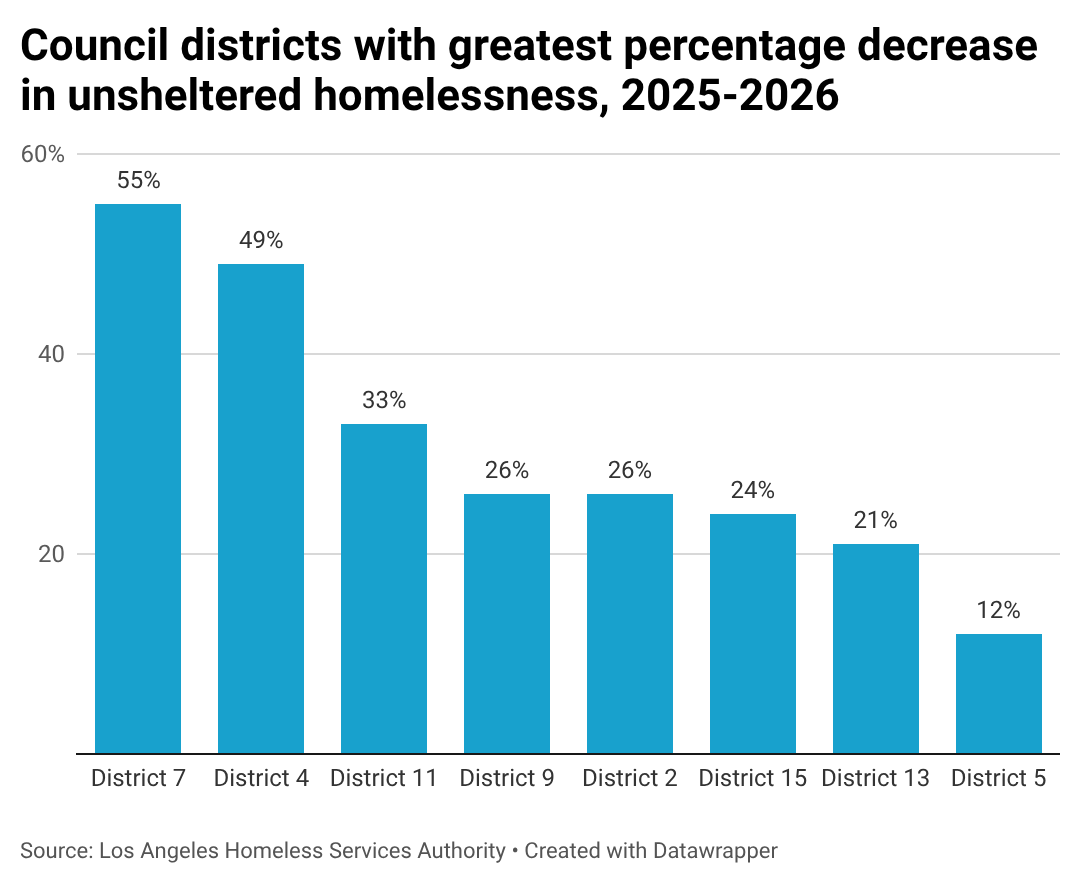
But the percentage change tells just part of the story. There’s also the raw number of people who came off the streets.
Raman’s District 4 registered 181 unsheltered individuals in February 2025 (delayed from the traditional January count by the wildfires), the second-lowest total (behind District 12). That means outreach workers could narrow their focus to a comparatively small population—by comparison, the citywide unsheltered count was 26,972 individuals across 470 square miles.
Many council districts had far higher homeless populations than District 4, and tactics that work in Encino don’t necessarily translate to Skid Row. District 14, which includes that downtown neighborhood, had 1,233 unsheltered individuals in 2025—the 2026 figure is 1,518.
Measured by raw totals rather than percentage changes, Raman’s district ranked sixth in 2026.
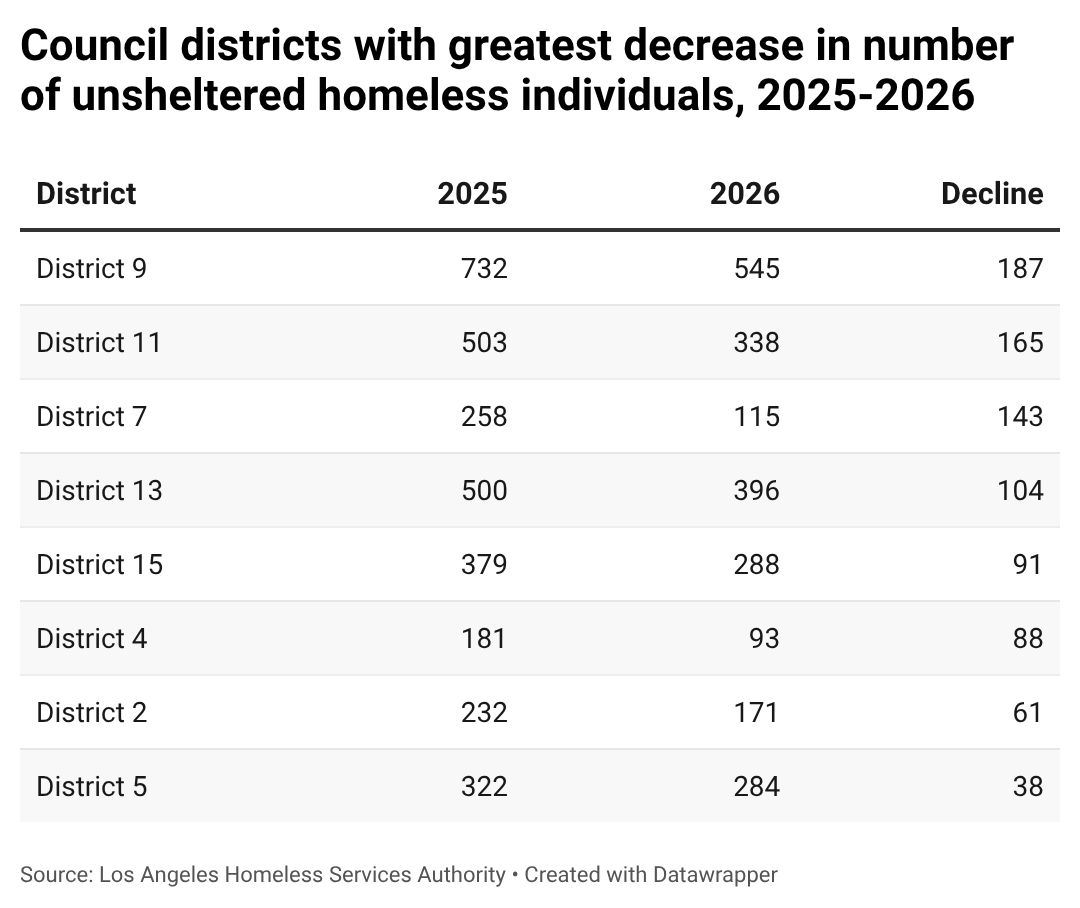
Also overlooked is that the 2026 decrease in District 4 runs counter to what happened the year prior: Between January 2024 and February 2025, according to LAHSA, unsheltered citywide homelessness fell 7.9%. That year, Raman’s district recorded a 9% increase, from 166 to 181 individuals.
***
As with Bass, tackling homelessness has been a cornerstone issue for Raman since she was elected in 2020. A Democratic Socialist, she has drawn praise in some quarters for her progressive approach to the issue, frequently stating that moving an encampment down the block does not get someone housed. She has also earned fierce criticism for her opposition to utilizing Municipal Code 41.18, which allows councilmembers to conduct cleaning sweeps of encampments in their district.
Raman started with a smaller homeless population in her district than most of her colleagues because her territory was carved up in the bitter 2021 city redistricting process; she lost some Eastside communities as high-income Valley neighborhoods such as Encino were shifted into District 4. The homelessness picture immediately changed—the 2020 Homeless Count had tabulated 1,072 homeless people in District 4, 952 of them unsheltered. (People in shelters are counted as homeless but not unsheltered.)
At the mayoral debate, Raman stated that the number of tents, RVs and makeshift shelters in District 4 has fallen by 70% in recent years. Her campaign team provided numbers to L.A. Reported showing the cumulative total went from 345 such dwellings in 2022 to 104 this year.
A spokesperson for the Bass campaign maintains that Inside Safe plays a sizable role, claiming that the initiative has gotten 216 people off the streets in District 4 since 2023.
Raman has ardent supporters who believe her efforts have led directly to less homelessness. On Aug. 12, U.S. Rep. Laura Friedman took to X to describe how, in 2020, when she was a State Assembly member, she and Raman worked together to address encampments under freeway overpasses in District 4. They created a task force and, Friedman wrote, “It worked. People were housed. The encampments disappeared.”
***
The annual Homeless Count involves a “point-in-time” tally conducted by volunteers over three nights in January. At the July presentation, LAHSA Chief of Staff Paul Rubenstein reiterated that the count is “designed to provide a snapshot of homelessness at the regional level.”
Council districts can see large year-over-year swings in certain categories, and the Homeless Count’s accuracy is frequently questioned. The Los Angeles Times recently discovered an “accounting glitch” that tabulated 614 more people occupying shelter beds in Skid Row than last year, even though the beds were not new. At an Aug. 26 council meeting, the panel took up a motion from Council President Marqueece Harris-Dawson asking for an investigation into why unsheltered homelessness in his Eighth District spiked from 309 to 701 people this year—with one particular census tract soaring from 19 to 277 unsheltered individuals.
LAHSA’s publicly accessible raw data for council districts covers the last three years, and Raman can indeed boast a sizable decline in both the number and percentage of unsheltered people. But she’s not alone: In that period, 10 districts saw decreases, with the biggest percentage drop in Adrin Nazarian’s District 2. Here’s how the numbers look:
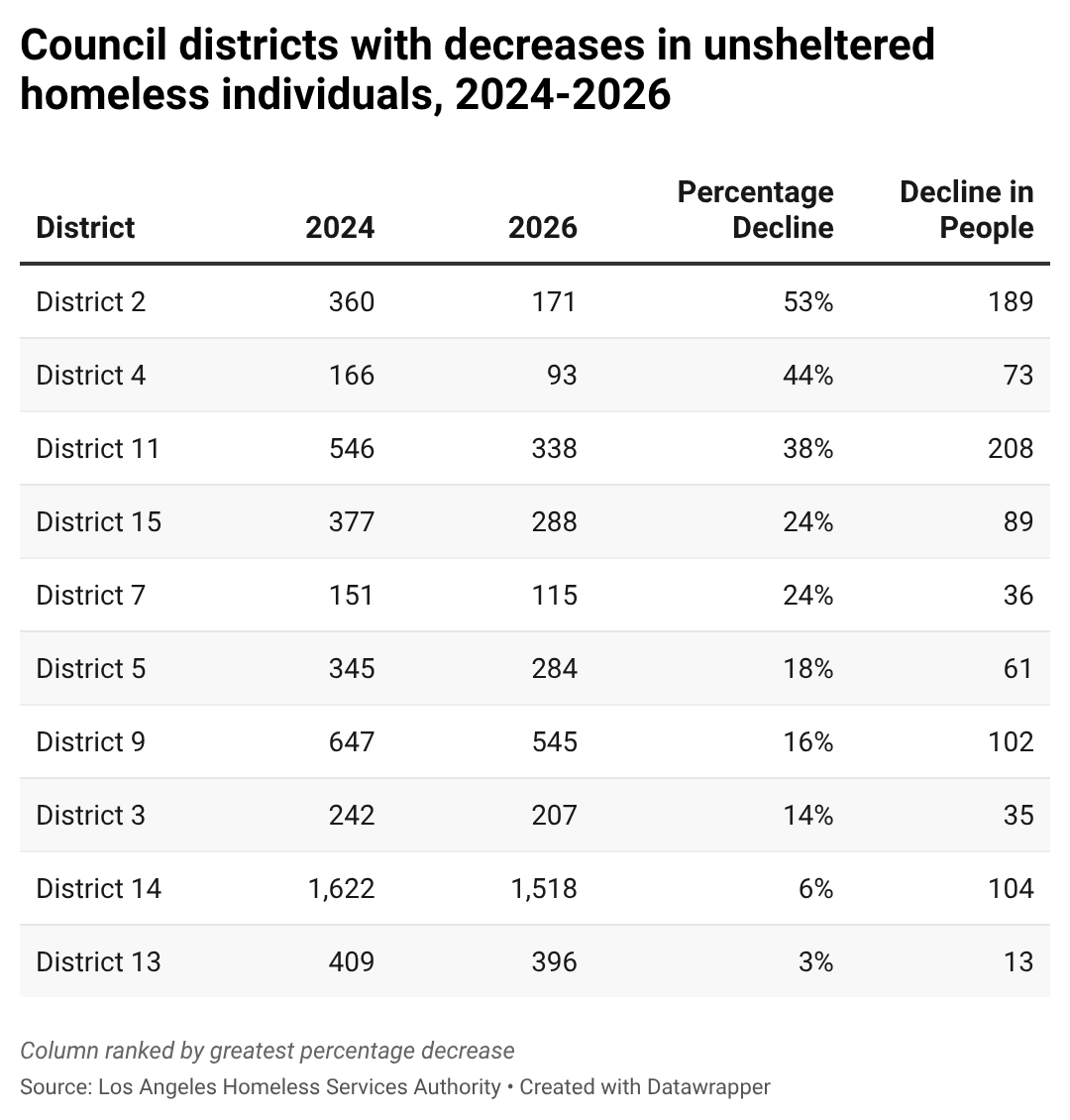
No matter how you slice the data, Raman has indeed presided over a substantial drop in homelessness in her territory—as have several of her fellow council members. Far less clear is whether, should Councilmember Raman become Mayor Raman, the whole city would experience the same success.
Jon Regardie is a Los Angeles-based journalist who has written columns, editorials, news, business, features and entertainment stories for dozens of publications. His numerous awards include three L.A. Press Club Journalist of the Year prizes. This is his first piece for L.A. Reported.
Jon. I live in the 4th and I don’t buy those numbers for a second. Homelessness is still a huge problem here. These are PR numbers only. Neither Bass nor Raman have a clue to resolve this issue but they’ve made no profit housing providers very wealthy.
I don't follow the angle here.
The headline frames the 49% as half a story, but nothing in the piece shows it's misleading. It's a real year-over-year drop, the district's small base isn't her own doing, and the 3-year trend is down, too.
The actual argument seems to be that other districts had big declines as well, which is good news, but not a reason she shouldn't promote her own number. Every campaign stat is a favorable snapshot, including Bass's two-year decline.
This reads like a hit piece that struggled to find anything to hit.