
The bullet train is off-track again
The rail authority’s inspector general warns that design changes violate state law.
By Ralph Vartabedian
To the long list of major problems bedeviling California’s bullet train, here’s a new one to add: The project now appears trapped in a financial and legal bind.
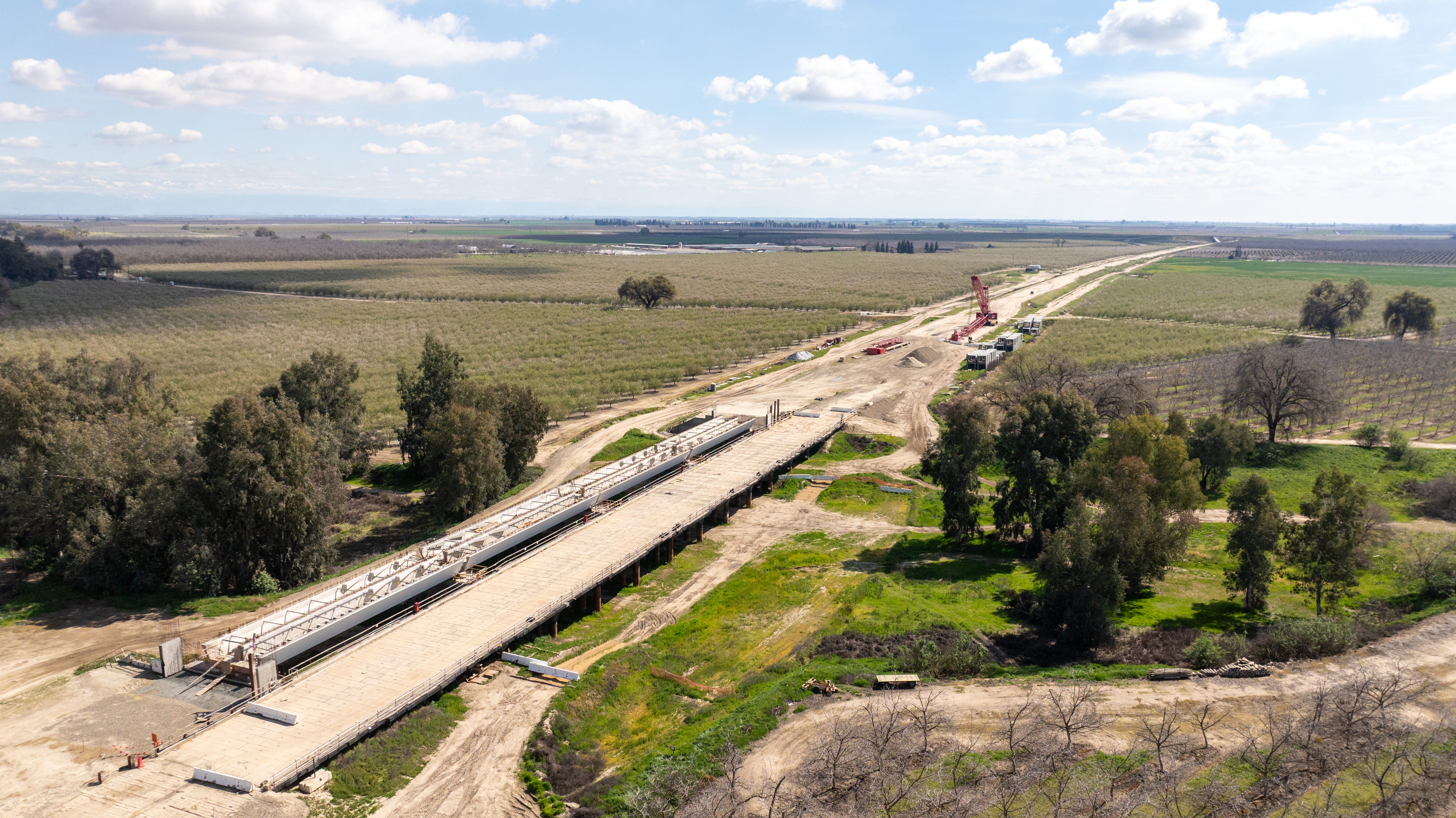
In order to afford the first section of California’s high-speed rail, from Merced to Bakersfield, the agency in charge of building the train recently proposed making significant unpleasant compromises, including stopping six miles short of downtown Bakersfield and three miles outside of downtown Merced, amid farm fields.
In order to comply with state law, however, the state-appointed inspector general said in a recent letter to the rail authority that it is required to connect the two downtowns. Nor is it allowed to make several other cost-saving cuts, such as laying one main track instead of two, which would force trains traveling in one direction to pull over on sidings to let trains from the other direction pass.
The Merced-to-Bakersfield starter segment was launched by newly elected Gov. Gavin Newsom in 2022, who asserted there was no realistic plan to complete the original goal of building a Los Angeles to San Francisco bullet train system that voters approved in 2008. Instead, efforts would focus on an initial segment within the Central Valley that could be completed with existing funding. That less ambitious effort has since encountered skyrocketing costs and delayed schedules that are tapping out funding and prompting the latest alterations.
The draft 2026 business plan issued earlier this year projected that the latest round of cuts and compromises would allow the initial operating segment to be finished for $35 billion by 2033, a deadline that the inspector general, Benjamin Belnap, has previously said is unlikely to be met.
The rail authority’s business plan asserts it has sufficient funds to complete the project, though the cost would have been an estimated $14 billion higher without the changes it has made. The implication is that Sacramento would have to find another $14 billion on top of the $35 billion estimated cost for the Bakersfield to Merced system to comply with the legal requirements.
The rail authority did not respond to written questions from L.A. Reported.
According to Belnap’s letter, the authority’s proposal to build only a single track over 89% of the route from Bakersfield to Merced violates a requirement in SB 198 that the route have dual tracks. The same law also specified stations in the downtowns of Bakersfield and Merced, he said.
The downtown Merced station was supposed to serve as the transfer point for passengers taking commuter trains to the Bay Area, as well as linking with Amtrak service from Sacramento.
Belnap said the draft plan also fails to provide a detailed funding plan for the construction of the Merced to Bakersfield segment that was required under AB 377.
“These omissions mask the true cost and timeline for completing the project’s initial operating segment as defined in statute,” Belnap warned. The “extent of these omissions makes the draft plan objectively incomplete and, if not addressed, noncompliant with state law.”
Many of Belnap’s conclusions parallel those of the Legislative Analyst’s Office. In a report delivered to the Senate committee, high-speed rail expert Helen Kerstein noted a lack of transparency in the draft business plan.
“The decision not to highlight information on key scope changes in the document — instead stating that cost savings are from unspecified ‘optimization measures’ — obscures the nature of these changes and makes comparisons between annual plans difficult,” she wrote.
Assemblyman David Tangipa, a Republican who represents parts of Fresno and nearby foothill counties that are near some of the rail construction, expressed outrage at the draft plan’s failure to comply with the legislation, including AB 377, which he introduced.
Noting that the bond act authorizing the project was approved in 2008, the 30-year-old legislator said, “I did not vote for high-speed rail because I was 12 years old at the time. And it’s looking like my children and my grandchildren won’t even be able to ride it.
“We should have infrastructure,” he said. “The current California High-Speed Rail Authority plan is not that. It is a fantasy.”
The latest criticism comes on top of recent reports by the rail authority showing that the bullet train’s high-speed segment would eventually run only from Palmdale to Gilroy, not Los Angeles to San Francisco as originally envisioned.
Despite the bullet train’s ever-lengthening list of troubles, political support remains robust in Sacramento. Sen. Dave Cortese, chair of the Senate Transportation Committee, whose district includes San Jose, where high-speed rail remains popular, defended the rail authority’s decisions in its draft business plan at an April 27 committee hearing.
“The project has to be completed,” he said in a recent KCRA interview.
Belnap’s letter appears to have forced the rail authority to rethink how it can legally achieve that goal. The business plan was on the rail board’s meeting agenda for approval in late April. After Belnap’s letter, dated April 15, it disappeared from the agenda.
The controversy over the business plan’s cuts was compounded on Friday, May 8, when Gov. Gavin Newsom replaced rail authority chair Tom Richards and vice chair Nancy Miller with two close political confidants, Steve Kawa and Jason Elliott.
The rail authority and the governor’s office declined to comment on whether the moves were related to Belnap’s concerns or to the board’s action to delay approval of the draft business plan. In a statement, a spokesman said Newsom “is committed to making sure leadership is in place to shepherd every dollar and every mile of track with continuous rigor and accountability.”
Exactly what would happen if Newsom and the rail authority ignore Belnap’s concerns about the business plan’s legal lapse is not clear.
Ethan Elkind, a rail proponent and director of the Climate Program at UC Berkeley’s Center for Law, Energy and the Environment, said, “It could be the subject of a lawsuit.” But he notes that for years California courts have taken a hands-off approach to the project.
“It is more a question of politics,” he said.
Ralph Vartabedian is a Los Angeles-based independent journalist who has reported extensively on the bullet train for the New York Times and Los Angeles Times.
What a disaster.
Well written, keep following this story for us.