
Penny Wise, Pothole Foolish
What’s the real cause of L.A.'s crumbling roads? The city's broken budgeting process.
By Constance Sommer
Following this winter’s heavy rains, L.A. motorists reported 6,700 potholes in January, a 49% jump from the previous month. In the past, L.A.’s Bureau of Street Services, also known as StreetsLA, used to try to “repair every pothole within the next business day,” according to a former version of the bureau’s “How Do We Fix Potholes?” page. The current page doesn’t mention repair times at all.
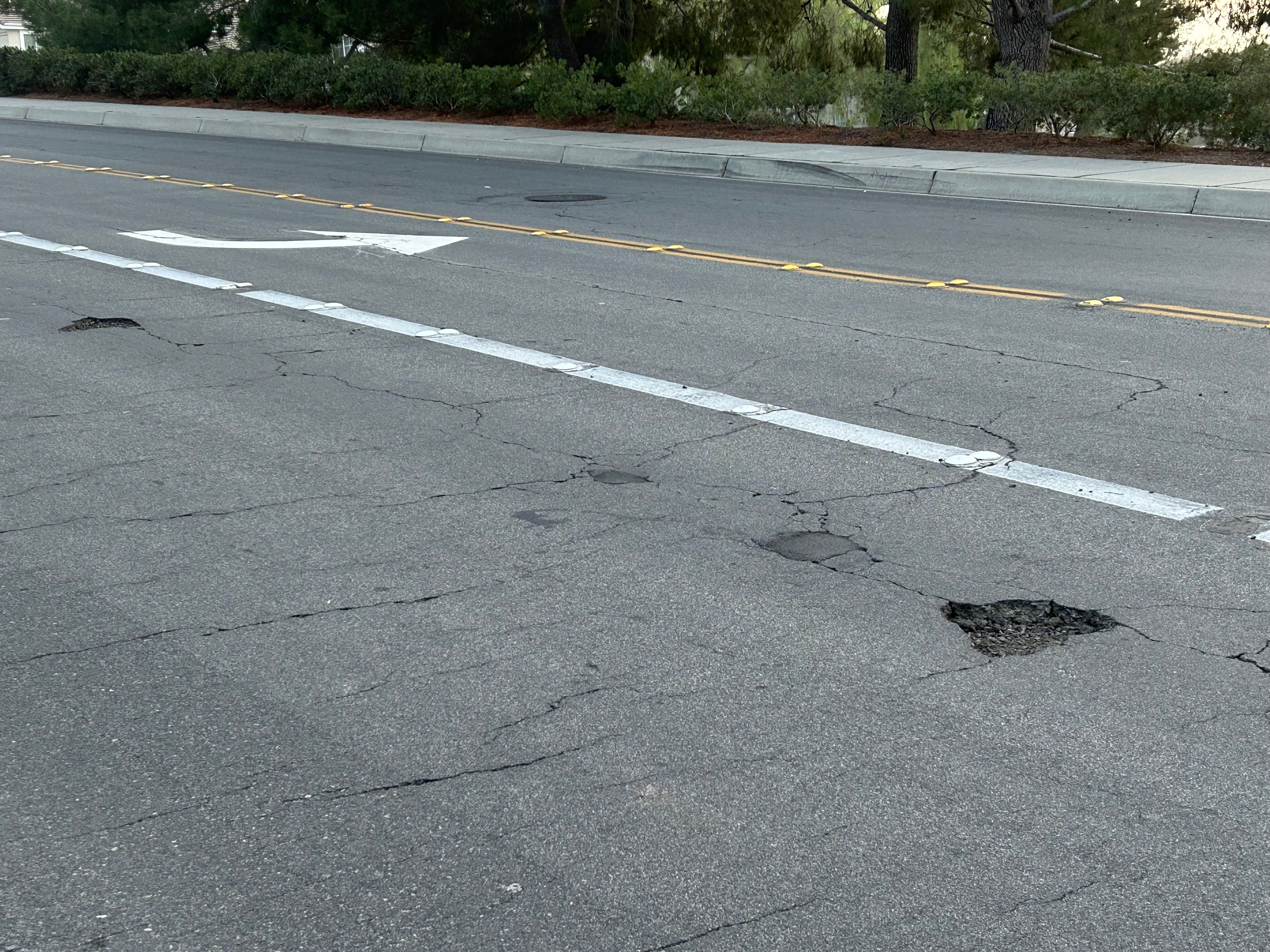
L.A.’s streets are falling apart. At public hearings city workers complain that they can barely keep up with even the most basic street services. Hundreds of street staff were laid off last year. Trucks remain parked at city lots because there aren’t enough people to use them to perform major repairs. Since last July, the city has made do with stopgap measures like plugging potholes and laying down rectangular asphalt patches that stop short of a full resurfacing of the road.
According to the city’s own measurements, 60% of its streets were in good condition a year ago. Now it’s 53%.
The city’s crumbling roads lay bare the costs of the city’s addiction to band-aid budgeting. Simply filling a pothole doesn’t repair the damage to the underlying structure of the street, which means potholes soon return, explains John Harvey, a professor of civil and environmental engineering at UC Davis, and the director of the UC Pavement Research Center.
“A pothole is the gravestone on a pavement that died previously,” he says.
“We’re trying to save money because we don’t have money, and yet we are mortgaging our future by making it much more expensive to get these streets in order later,” says Michael Schneider, the founder and CEO of Streets for All, a Los Angeles-based nonprofit advocating for streets that make more room for pedestrians and cyclists.
Streets for All released a report in April that modeled how bad the city’s streets could get if Los Angeles continued down its current maintenance path. Right now the city has an $8 billion backlog. The report projects that the backlog will swell to $15 billion by 2035.
As the report noted, eliminating cracked pavement isn’t all the city has put off. It has, the report alleged, purposely engaged in patchwork rather than resurfacing in order to delay having to make legally required improvements to pavement.
The Americans with Disabilities Act, signed into federal law in 1990, mandates that cities install sidewalk curb cuts at street corners when they do street repairs. Then, two years ago, city voters passed Measure HLA, which orders L.A. to add lanes for bikes and buses whenever the city does major resurfacing. The city’s streets bureau says it cannot afford to meet the demands of either the federal government or local voters. So, as of July 2025, Los Angeles halted all major street repaving across the city. This kind of municipal budgeting — delaying pavement maintenance for a year, or two, or more — can seem to make sense in the short term, says Brian Taylor, a professor of urban planning and public policy and a research fellow in the Institute of Transportation Studies at UCLA.
“But then the roads start to break down and it cascades,” Taylor says. “It’s like getting caught in credit card debt. The interest gets worse and worse and you fall farther and farther behind.”
This past year has been one of hard fiscal choices for Street Services. The city has slashed its budget for two years running, resulting in a 26% workforce reduction. These “severe” cuts, the bureau wrote in its November budget request to the mayor’s office, “created too many operational holes, and has resulted in crews being dismantled, consolidated, or shut down.” Sometimes, the cuts themselves are costly, the bureau wrote, as “crews can remain idle and have to await truckers or equipment operators to perform work.”
The result: Los Angeles resurfaced 312 miles of roads last year, less than half of the 850 miles or so of pavement it repaired annually in the late 2010s. This year, in a city with 23,000 miles of roads, the bureau is on track to repave 100 to 160 miles of road, according to Streetsblog LA, a daily online publication reporting on transportation and sustainability issues in the city. The majority of that repaving, about 100 miles, is large asphalt repair, Streetsblog LA reported. The patches are short, less than 1/8 of a mile, leaving at least some portion of the street untouched, and often end just short of crosswalks, avoiding intersections. These limits are strategic and deliberate, critics charge.
The length is the city’s attempt to avoid HLA restriping, contends Joe Linton, editor of Streetsblog LA, in the latest of two lawsuits he’s filed against the city, trying to force it to adhere to HLA standards. The patches don’t run curb-to-curb or into intersections to avoid triggering ADA mandates for new or improved curb cuts, Streets for All alleges in its report.
“It’s just gross,” says Oren Hadar, who writes a newsletter examining the city’s housing and transportation woes, called The Future Is LA. In December, Hadar broke the story about how the city had ceased major repaving. “Really? Somebody is sitting there, with a mapping tool, figuring out, okay, well, how do I make this 659 feet so it doesn’t trigger HLA? I mean, it’s just awful to think that they’re planning this out.”
Mayor Karen Bass, facing re-election this year and under fire from opponents who accuse her of neglecting city infrastructure, proposed a budget in April that restores 170 of the 406 positions StreetsLA lost to budget cuts in the last two years alone. She’s also proposing increased funding for constructing ADA-compliant curb ramps and street repairs.
It’s too little, too late, said Adam Miller, one of Bass’ challengers in the mayor’s race. If the city doesn’t allocate substantially more resources towards its pockmarked streets, “you’re driving the city into the ground,” he said. The Bureau of Street Services directed a request for comment to the mayor’s office, which did not respond to multiple emails.
Los Angeles also continues to grapple with the legal fallout from its failure to meet ADA standards — most significantly the Willits class-action suit. That suit resulted in a 30-year, $1.4 billion settlement in 2016, mandating that L.A. fix its broken sidewalks and add curb ramps. Los Angeles reports paying $50,000 per curb ramp, meaning repaving an intersection could cost $200,000 in curb ramps alone (by comparison, a 2021 Kaiser Health News investigation found the average national cost of curb ramps to range from $9,000 to $19,000 each). With the city finding, year after year, that it cannot come up with the funds to meet the demands of Willits, council files show that as recently as mid-March, the council’s Public Works Committee met in a closed-door session to discuss the settlement.
L.A. paid out $1.4 million in settlements in fiscal year 2024-2025 to people who tripped and fell on city potholes. The city does not have a category solely for pothole claims for vehicles, which could include cars or bikes (the closest number is the $5.2 million the city paid out last year for roadway maintenance claims).
The pothole problem is just a small piece of overall lawsuit costs for “dangerous conditions” on the city’s streets and sidewalks. In the last fiscal year, the city paid a total of $54 million in settlements — a 35% increase from the previous year and more than double the total five years before.
Liability claims are paid out of a central fund, not by the department that triggered the claim. For the coming fiscal year, the city controller’s office expects to spend $106 million on liability claims and financing for Street Services — roughly three-quarters of the $141 million it will pay the department’s workers, the very workforce it has spent two years cutting.
Spending less now is supposed to save money. But the money the city doesn’t put into streets is spent on the consequences of not spending on streets — settlements, legal bills, and repairs that cost more every year they’re deferred.
In the meantime, Street Services continues to deploy what crews it has to patch streets, while beneath the patches, the streets’ aging pavement grows more and more fragile.
“Is anybody developing some kind of strategy, whether it’s spending more money on curb ramps or giving more money to construction crews?” Hadar said. “Because it can’t keep going like this.”
Constance Sommer is an independent writer living in Mar Vista. Her articles and essays have appeared in the New York Times, Los Angeles Times, Associated Press, Vogue, and Westways (AAA) Magazine, among others.
The third to last paragraph says it all!! Great article Connie.