
By Arushi Goyal
Around the world, from Sydney, Australia, to Austin, Texas, there’s one climate-friendly technology that almost everyone suddenly seems to love: home batteries. Environmentalists prize their ability to hold onto clean solar energy for use after dark. Engineers value them as a low-cost tool to strengthen the electric grid. Homeowners like being able to keep the lights on and the fridge running during blackouts.
And yet—as battery sales spike in sunny cities around the globe—here in Southern California there is one giant exception to the battery boom: the city of Los Angeles, where home batteries remain as rare as rain in July.
Up until mid-2023, L.A. city residents were buying batteries at roughly the same low rate as their SoCal neighbors. Then sales took off—everywhere except in L.A. Three and a half years later, homeowners in the city of L.A. are buying batteries at one-fifteenth the rate of their neighbors everywhere else in L.A. County, according to permitting data. (See chart.)
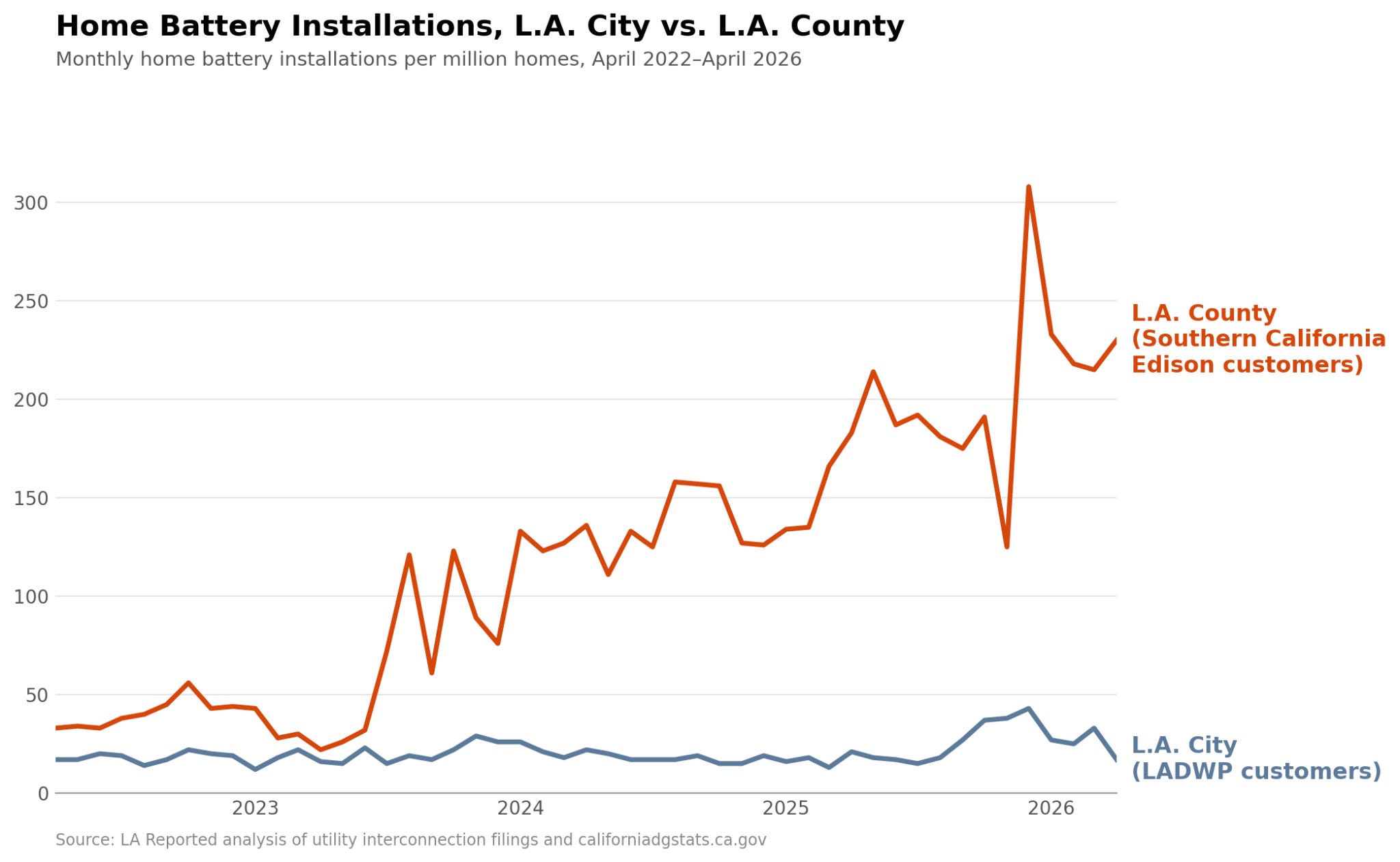
On its face, the vast discrepancy seems to make no sense. Mar Vista and Mount Washington, which are inside L.A. city limits, get just as much sun as Malibu and Monrovia, which aren’t. The city of L.A. has one of the nation’s most ambitious climate goals—including a pledge to have a zero-carbon electric system by 2035—which should make it especially eager to adopt new technologies that make better use of solar energy.
Timothy O’Connor, who serves as the independent ratepayer advocate for the Los Angeles Department of Water and Power, says that Angelenos could benefit from the rapidly improving technology. “Batteries have become more valuable as an additional resource that really wasn’t around in the size and scale and potential that it is today,” O’Connor says. “Getting this technology deployed is going to help ratepayers at large.”
Yet LADWP has shown a unique disinterest in the promising technology. Since April 2023, every other large California utility has offered incentives for customers to install home batteries. LADWP has not. That inactivity mirrors the city-owned utility’s inability to modernize the way it prices residential electricity, changes that other California utilities adopted in 2015.
As America’s largest publicly owned utility, LADWP operates independently of the state regulations that govern the privately owned utilities delivering power to most Californians. In theory, that gives it the freedom to respond nimbly to changing technology without having to worry about private investors.
In practice, it hasn’t worked out that way. On April 15, 2023, the California Public Utilities Commission, which oversees the privately owned electric utilities, gave a big boost to the home battery market when it changed the rules governing how utilities pay customers for the rooftop solar power that they send back to the grid.
Those new solar payments reflected the changing realities of California’s electric system, which now generates more power on many sunny days than the grid can use. Unable to store all the excess electricity, grid operators “curtail” surplus solar generation, essentially throwing away free, clean energy. The new rules aimed to mitigate that problem. Instead of paying a high, flat rate for all rooftop solar power, the new “net-metering” rules cut daytime prices when the grid didn’t need much power, but paid a premium for power that batteries stored during the day and released after the sun set.
The effect on battery adoption rates outside LADWP territory was immediate. Before the change, only about one in 10 new residential solar systems in California’s investor-owned utility territories included a battery. Under the new billing system, that share rose to roughly six in 10.
Does LADWP’s municipal ownership explain its failure to make use of new technology? No, says Severin Borenstein, an economist at UC Berkeley’s Haas School of Business and director of its Energy Institute. In fact, he points out, the one California utility that has moved the most aggressively and effectively to integrate new home batteries is the one that’s otherwise the most like LADWP: the utility owned and operated by the city of Sacramento.
The Sacramento Municipal Utility District, known as SMUD, offers homeowners who install home batteries huge upfront payments of up to $10,000. In exchange, the utility gets to control when those batteries store and discharge electricity. The system then acts as a “virtual power plant,” in which a large group of home batteries under utility control mimics the power output of a traditional power plant.
The sales pitch to Sacramento homeowners who join that virtual power plant is simple and compelling: with a battery, you will save money, cut your carbon emissions and have backup power during a blackout. What’s not to like?
LADWP already makes use of one old-fashioned—and extremely large—energy storage system: Lake Castaic operates “pumped hydro,” which uses excess energy to pump water uphill and then releases it to turn turbines and generate power. Lake Castaic and large “utility scale” battery installations, play a key role in helping the grid make use of wind and solar energy.
O’Connor, the ratepayer advocate, says that because of bottlenecks in L.A.’s grid, and the difficulty in building new wires and substations in the city, home batteries play a valuable complementary role. Distributed energy storage “helps to improve the utilization rates of the existing infrastructure we have and reduce future costs,” O’Connor says. “The cheapest and easiest transformer to install is the one that you don’t have to, so that’s one of the big benefits you get by having distributed energy resources.”
A spokesperson for LADWP says that it is working on a similar plan to the one Sacramento launched in 2023, encouraging Angelenos to buy batteries and tie them together in a virtual power plant. That plan is targeted to start early next year, according to LADWP. Details on exactly how it will compensate battery owners haven’t yet been released.
“Everyone pretty much agrees that we need a lot more battery capacity on the grid,” says Prof. Borenstein, but the right mix of “small batteries in people’s garages or large batteries in substations is still a point of contention.”
Less debatable: that after years of delay, the right amount of home batteries in L.A. is a lot more than it has now.