
Cracked
Why did Los Angeles design a street repaving plan that prioritizes Bel Air over Boyle Heights? Not for the reasons you might think.
By Constance Sommer
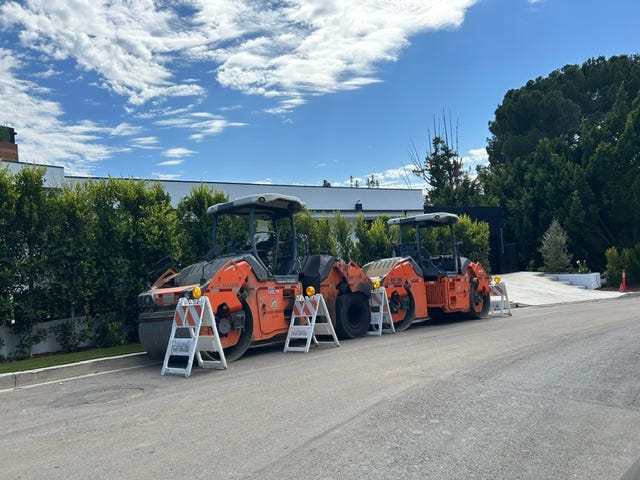
After nine months without resurfacing a single street, the city of Los Angeles has begun the arduous task of ripping out undermined asphalt and replacing it with new pavement. Residents of two blocks of Valley Meadow Road in Encino now pull out of their gated compounds onto freshly poured pavement. Signs on a couple of blocks of Bellagio Road in Bel Air, where a home sold for $5 million in January, promise residents that they will soon enjoy similar improvements. Other newly repaved streets can be found in residential neighborhoods in Northridge, Granada Hills, and Mount Washington.
Yet those repairs do nothing to address the cracked streets and buckling sidewalks that affect the livability of the city’s more densely populated urban neighborhoods, says Earl Ofari Hutchinson, the founder of the Los Angeles Urban Policy Roundtable, a community activist group based in South L.A.
Instead, almost all of the new round of resurfacing, along 50 miles of roads, has been in residential, wealthier-than-average L.A. neighborhoods. The city did repave about three miles of major arterial streets, including a mile and a half of Martin Luther King Jr. Boulevard, but that leaves more than 90 percent of the work outside the urban core. “The streets in many residential areas are cracked, broken, and split,” Hutchinson wrote in an email to L.A. Reported. “The city has been astoundingly neglectful.”
The disparity begs the question: Why is the city repairing its less-traveled streets instead of tackling problems that would benefit the most residents, regardless of income?
The explanation, it turns out, can be traced back not to the political power of the wealthy, but rather the bureaucratic incentives driving decisions in a cash-strapped city.
Costs were the reason that the city’s streets bureau, also known as StreetsLA, halted its resurfacing efforts last year. The agency was too broke to take on new requirements involved in repaving, its general manager, Keith Mozee, said in a public hearing in January. These upgrades included striping for bike and bus lanes as mandated by Measure HLA, passed by city voters in 2024, and installing improved curb ramps that allow wheelchair access, as mandated by the Americans with Disabilities Act, or ADA. At $50,000 per ramp, Los Angeles has some of the highest ramp installation costs in the country.
Both requirements hiked the cost of resurfacing — at least on most heavily trafficked city streets. But most residential streets aren’t included in the HLA mandate. And when those streets also lack sidewalks, as many wealthy neighborhoods do, that dispenses with the need for pricey curb cuts as well.
“It’s letting the city resurface streets without having to deal with curb ramps, is what it’s solving,” Michael Schneider said about this spring’s resurfacing. Schneider founded the L.A.-based nonprofit Streets for All, which advocates for streets that make more room for pedestrians and cyclists.
City officials said they would try to answer L.A. Reported’s questions about the resurfacing, but as of June 27th, they had not replied or made anyone available for comment.
Schneider says he frequently talks to people who work in the bureau, and they tell him there’s another reason why the city began its cheap-fixes-first repaving effort this spring. The city’s fiscal year ends on June 30th, and if StreetsLA ends the year with any extra money in its account, it could make itself vulnerable to bigger fiscal cuts next year.
“They don’t have the money for curb ramps but they don’t want to leave money on the table,” he said. Plus, the city’s Department of Transportation, which oversees HLA restriping, is under orders from the mayor to not launch any new projects not directly related to the upcoming 2028 Olympics, according to Schneider.
“What is the nexus of all of those?” he said. “This little tiny category of streets that I can actually spend that money on. I’ve got to hand it to [Mozee]. It’s very creative.”
That leaves Angelenos such as Hutchinson and his neighbors in South L.A. to wonder how much longer they will have to wait, and how many more complaints they will have to lodge, before the Bureau of Street Services and its sister agencies begin work on their communities’ neglected streets and sidewalks.
“The bureau has done almost nothing,” he wrote. “They have repeatedly ignored the complaints from residents to make repairs. There is zero accountability and city officials have done nothing to correct that.”
Transportation experts say that resurfacing is the only long-term fix for the never-ending rounds of potholes and cracks in streets. Patching potholes is not only temporary, it actually further undermines the streets. And because of the intense winter rains, potholes were blooming throughout the city, with 6,700 reported in January alone. Instead of resurfacing streets for smoother, more long-lasting pavement, the city has mostly filled the holes, as a previous story by L.A. Reported revealed.
Half of the city’s 23,000 lane miles of streets are in need of resurfacing. Fifty down, 11,450 to go.
Constance Sommer is an independent writer living in Mar Vista. Her articles and essays have appeared in the New York Times, Los Angeles Times, Associated Press, Vogue, and Westways (AAA) Magazine, among others.