
The fires, one year later

Thank you for joining us for our very first newsletter! We’re proud to start with pieces by two of L.A.’s most prominent nonfiction writers telling deeper stories about the wildfires that were still burning a year ago today.
Your home is the new wildfire battlefront
By Robert Greene

As California fire officials repeatedly blow through deadlines for adopting statewide landscaping restrictions in high fire hazard zones, the Los Angeles City Council is moving ahead — though not necessarily in the way the state intended. On Tuesday, the council endorsed rules that would require homeowners to remove some combustible materials from a five-foot buffer zone around their houses to decrease the chance that wind-blown embers could ignite plants or wood fences and then destroy the homes.
At first blush it might seem that the council, still struggling with the fallout of last year’s deadly Palisades wildfire (and simultaneous fires in Altadena and other areas outside L.A. city limits) is finally fed up with waiting for the state Board of Forestry and Fire Protection to act. More than five years have passed since Gov. Gavin Newsom signed a bill requiring the board to adopt statewide rules for the ember-resistant barrier, known as Zone Zero. There are still no rules. But the council’s concern is that the state will move too quickly — and rigidly.
The state board has floated several options, some more stringent than others. The rules L.A. is pushing ahead with would be far less restrictive, out of concern that the state mandates might cost homeowners too much without necessarily being effective: Pulling out plants, replacing wood fences, taking down wood planters and moving pergolas all would cost homeowners plenty. Critics complain that the result would be a zone of nothingness — stark, lifeless, unornamented.
In contrast, San Diego in December adopted strict rules that kick in for new construction next month and for existing homes next year. Berkeley’s regulations took effect Jan. 1.
The different rules all attempt to strike the proper balance between protecting homes and protecting the livability and aesthetics of California as we know it. Is it wise public policy to require massive, costly changes in the absence of conclusive evidence that they work? Or, since scientific study will be continuing for decades, is it even more foolish to delay taking aggressive actions that are likely to reduce the unpredictable spread of fire from embers?
The state rules, as envisioned so far, would transform much of the iconic Los Angeles suburban landscape: bougainvillea or ivy draped over entryways, tropical flowers blossoming from well-watered soil. But then, residential yard design here has often incorporated a hefty dose of fantasy, including misplaced woodsy motifs borrowed from the rainy English countryside, to transform the feel of the dry Western landscape.
You can grow almost anything in L.A. — with enough precious water and as long as Santa Ana winds and wind-blown fire don’t take them down and with them, your house.
Zone Zero opponents have also questioned the scientific expertise behind the not-yet-adopted state rules, and have offered their own experts and evidence to defend their claims that at least some plants — well-watered succulents, for example — might actually protect homes from embers.
The real estate industry and homeowner associations find themselves at odds over Zone Zero with insurers and firefighters. But remember this: Those same groups once faced off over laws to ban wood-shingled roofs in high-fire-risk areas, a change now almost universally seen as basic common sense.
The squabbling has repeatedly derailed statewide fire-safety rules, despite a succession of horrific Northern California wildfires amid a drought that began in 2011. The 2017 Tubbs Fire wiped out a large chunk of Santa Rosa, then was exceeded the next year by the Camp Fire, which swept through Butte County, killed 85 people, destroyed more than 18,000 buildings and obliterated the town of Paradise. All told, more than 1,000 large-scale fires burned in California in 2018, killing more than 100 people.
But most of the fires were in areas with names like Butte, Shasta, Trinity, conjuring the image of wildfire as something that strikes mostly distant, rural areas. That led to a widely held impression that people who lost their homes and even their lives were authors of their own fates for choosing to live in the Wildland-Urban Interface. Building a home in paradise (or Paradise) comes with certain risks. At least the fires of 2018 didn’t touch suburban communities. Like, say, Pacific Palisades. Or Altadena.
In fact, not only are many suburban and some urban areas within Very High Fire Hazard Severity Zones but the number keeps expanding, in part because of improving fire science, and in part because a changing climate is subjecting more of the state to extreme fire risk.
Nor is living outside of an official danger zone any guarantee of safety. Most of the parts of Altadena that were destroyed in the Eaton fire did not fall into the highest risk zone in March 2025, when the most recently updated maps were released. (You can use this tool to see whether your house is in a high fire hazard zone.)
The current debate kicked off in 2019 with a bill to require a five-foot, plant-free, ember-resistant zone in all high-risk areas. Gov. Gavin Newsom vetoed it, saying he couldn’t support a one-size-fits-all approach that failed to recognize the varied needs of different communities.
Just one year later, though, Newsom signed a similar bill, after fire experts testified that structures weren’t necessarily gobbled up by flames moving in a steady front, but more often burned when wind-carried embers hopscotched far ahead of the main fire to ignite wood fences and other flammable items, including landscape plants.
They also repeated the same warnings they’d been making for years: The Wildland-Urban Interface is not limited to developments directly facing forests, brushlands or other open space. Any leafy neighborhood subject to dry, downhill-rushing winds (the Santa Anas, for example) had of late simply been enormously lucky. Had we forgotten the deadly Oakland Hills fire of 1991? The Bel Air fire of 1961? Urban communities needed ember-resistant zones as much as anyone, they said.
The legislation called for the nine-member Board of Forestry and Fire Protection to adopt rules by Jan. 1, 2023, specifying what could and could not remain in Zone Zero. But the deadline came and went as homeowners complained about onerous and often expensive proposed requirements to denude their yards. More galling, many of them had recently ripped up lush lawns at the behest of state officials and experts, installing environmentally friendly native plants that are lush in the rainy season but that may crisp up in summer heat. Planted trees and tall bushes to cast cool shadows on plaster walls that would otherwise bake in the sun and require more electricity to keep air conditioners running longer. Supported an “urban forest” that promotes biodiversity and replaces lost habitat for birds and other creatures.
Now we have to reverse all that?
Would any plant be banned from the zone? What about juicy succulents that might actually block blowing embers from reaching the house? What if we recently replaced our ugly chain-link fence with a beautiful and costly, but flammable, wooden one? Do we have to re-uglify our property? What if there’s a law (and there is, in some cities) that criminalizes cutting down native oak trees in our own yards? Does it take precedence over this new law that now might criminalize not cutting down oak trees? And how are we going to pay for all of this?
Board members trying to balance fire-safety needs against the burdens and costs to homeowners essentially gave up for two years.
Then came January 2025.
Hurricane-force Santa Ana winds swept down Eaton Canyon and roughed up the Santa Monica Mountains. Firestorms destroyed much of Pacific Palisades, Altadena and neighboring communities. At least 31 people died in the flames and smoke, followed by an estimated 440 deaths due to toxic air or delayed medical care. Approximately 16,000 homes and other buildings were destroyed. And this had happened here, in suburbia. Newsom ordered the Board of Forestry and Fire Protection to get back to work on the Zone Zero rules, and to wrap up by the end of 2025.
“Believe the science — and your own damn eyes,” Newsom said. “Mother Nature is changing the way we live and we must continue adapting to those changes.”
The board held hearings and workshops although, oddly, stuck close to its Sacramento home until a September session in Pasadena, where homeowner pushback was harsh. The board again missed Newsom’s deadline, and now will not act before its March 10-11 meeting.
The homeowners argued that the science of Zone Zero is far from complete, despite the high level of confidence that state fire experts expressed at legislative hearings. Is a row of Italian cypresses, for example, a protective wall that blocks blowing embers from reaching the house? Or is it a source of more embers? Or both?
Los Angeles City Councilmember Traci Park said the Fire Board needs to take a lot more time to get it right.
Park, whose district includes Pacific Palisades, told the Los Angeles Current Affairs Forum on Jan. 12 that residential landscaping is only one of many responses to consider, including home-hardening (double-paned windows, for example, and tight metal mesh over vents).
“Of all the things that went wrong on Jan. 7, I’m not ready to blame the trees,” she said.
David Lefkowith, president of the Mandeville Canyon Association, questions the certainty expressed by fire experts and the insurance industry.
“The science around fire is like religion,” he said. “Different people just believe different things.”
Lefkowith also pointed out that the cost estimates of complying with Zone Zero rules generally leave out indirect but very real expenses, like higher electricity bills for the additional air conditioning needed to keep homes livable once shrubs that shade south-facing windows are removed. Or the cost of repainting after removing clinging vines from walls. Or the hazard posed by storms once hill-stabilizing plants are pulled out.
After going door-to-door examining dozens of yards and houses in Mandeville Canyon, Lefkowith estimated that compliance with proposed Zone Zero rules would cost his community between $50 million and $60 million.
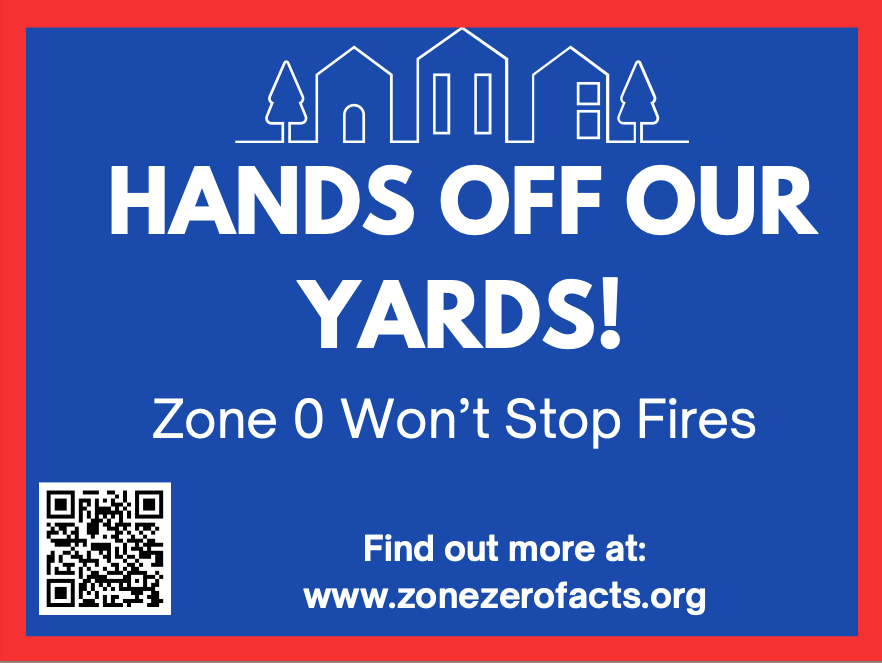
The board has generally stood its ground on the science, citing more than a decade of studies from as far afield as Australia and Alberta, and side-by-side burn demonstrations by Cal Fire, the agency of which it is a part. But it also acknowledged a widely cited study suggesting that plants should be studied based on how well-watered they are.
The state is required to consider the cost of homeowner compliance, and competing shade and water-saving needs. What we know so far: It likely will not require removal of mature trees, as long as they are trimmed to avoid becoming wicks that could carry flames up to roofs. Fallen leaves would have to be cleared (constantly) from the ground and the roof. Branches must be cut back to no more than 10 feet from chimneys. Wood fences within the five-foot zone will likely have to go, but as a concession to homeowners, not wood balconies or decks — even though they could easily catch blowing embers. Hedges and shrubs that sit under eaves will likely have to go, even if they provide needed shade. Property owners will get three years to comply.
Last January, I was unaware of the 2020 legislation to require a five-foot ember-resistant Zone Zero, and I had only recently learned that my house, in a not particularly woodsy part of Highland Park in Los Angeles, was deemed to be in the high-risk zone. All I knew was that the weather reports warned of the coming super-Santa Anas, and I was nervous. I looked at my wooden balcony, draped with a Rogers Red grapevine that I planted after months of research. It once seemed perfect: a hybrid between a native California grape and a wine grape, with tiny berries for the birds and leaves that glowed bright red in autumn. It grew next to a tangerine tree that bears fruit I can pick from the balcony, and a rambling bougainvillea growing just short of my bedroom window. It was the whole package: California heritage, shade, fruit, wildlife habitat, low water consumption, stunning good looks. But with the dry wind picking up, every piece of that tableau suddenly seemed menacing.
As it happened, I was packing up to move out of my Highland Park neighborhood for three months of renovation and a temporary stay 10 miles to the northeast. Altadena. My wife and I were in our new home for three days before it burned down in the Eaton Canyon fire. It was just a rental, and the two of us (and our cat) escaped safely. But we lost our clothes, books, furniture, computers, kitchen gear and personal mementos it still hurts to think about.
When I was finally able to return to the scene, I saw that although the house was gone, the trees remained. A thin strip of lawn in the front was still green, almost lush. But there weren’t any plants remaining within five feet from the house. It was impossible to tell whether the burning walls had ignited the plants, or, at least as likely, the other way around.
I felt lucky. Nature had shaken a fiery finger at me by taking my temporary home but kindly left intact my own Highland Park house, with its wall-hugging vines and other flammable accoutrements.
Much of California has been periodically swept clean by fire for thousands of years, and there is nothing we can do to stop it. Science tells us that we’ve made things worse by trying to stop natural fires and thus allowing brush to build up and trees to grow too dense, then by building in the Wildland-Urban Interface. California’s Native American tribes used to set prescribed burns for various reasons, among them to reduce brush near their dwellings. That method doesn’t work in urban and suburban settings, but we still can minimize the fuel that turns an ember into a torch into a conflagration.
I was just a toddler in 1961, too young to remember the Bel Air fire that destroyed nearly 500 houses and injured hundreds of firefighters. One other thing it should be remembered for: the debate it sparked over wood shake and shingle roofs, which were widely considered an essential part of the woodsy look of that wealthy neighborhood. Proposals to ban such roofs, many argued, would eliminate the area’s special feel. Sound familiar?
Robert Greene is an independent writer based in Los Angeles. He previously wrote for the Los Angeles Times, where he won the Pulitzer Prize.
My year as a fire nomad
By Deanne Stillman

L.A. was always a water mirage and there have always been droughts, but this was the truth of it: In the land that the original residents called “The Valley of Smokes,” the firemen turned on the tap but the reservoir was empty.
Soon came the thrill of hearing the announcement that “they’re dropping the Phos-Check now.” Has a ring to it, like Sig Alert, I remember thinking when the planes finally arrived after the damage was done…isn’t the poetry of L.A. grand?… I actually feel a heightened sensation when the jargon kicks in, and then a few days later when the Pacific Palisades had succumbed to the inferno, all that was left was the oddly soothing rhythm of the headlines. “There is now a red flag alert for all of Los Angeles…northbound and southbound PCH is closed…”
I never thought this kind of danger would come into the residential area where I lived, just north of the bluffs at Asilomar in Pacific Palisades, south of Sunset, and west of Temescal. My beloved Temescal Canyon! I’ve told my friends that I lived at the corner of Sunset Boulevard and the Ice Age, of flora and fauna that invoke the Pleistocene, and mountain lions that are probably watching you on the trail, tracing a line from the sabertooth tigers of yester-millennium right through the 21st century, not by blood but by spirit and ways.
So it was hard to leave — to flee — this place that I loved but run I did a year ago on Jan. 8 as the flames headed east from the coast on Sunset, right past Starbucks in the Highlands where cars had stalled and were on fire and drivers were getting out and running down the street, following me in fact, as I finally emerged from the bumper-to-bumper traffic on my two-lane street, turning right on Temescal and heading for the beach — water! — just as flames fully engulfed a plant emporium, half of Palisades Charter High was burning down, and palm trees on either side of me were lighting up as if bursting from the inside and the heat had traveled up through the fronds, causing a spontaneous combustion of L.A.’s most enduring symbol.
Also in this issue:
Quick and cheap fire protection
By Lucy Jaffee
You don’t have to wait for the state to act. Here are six quick, cheap ways to protect your home from embers.
That’s it for our first edition. Thanks for joining us. Reply to this email anytime — we read everything.